
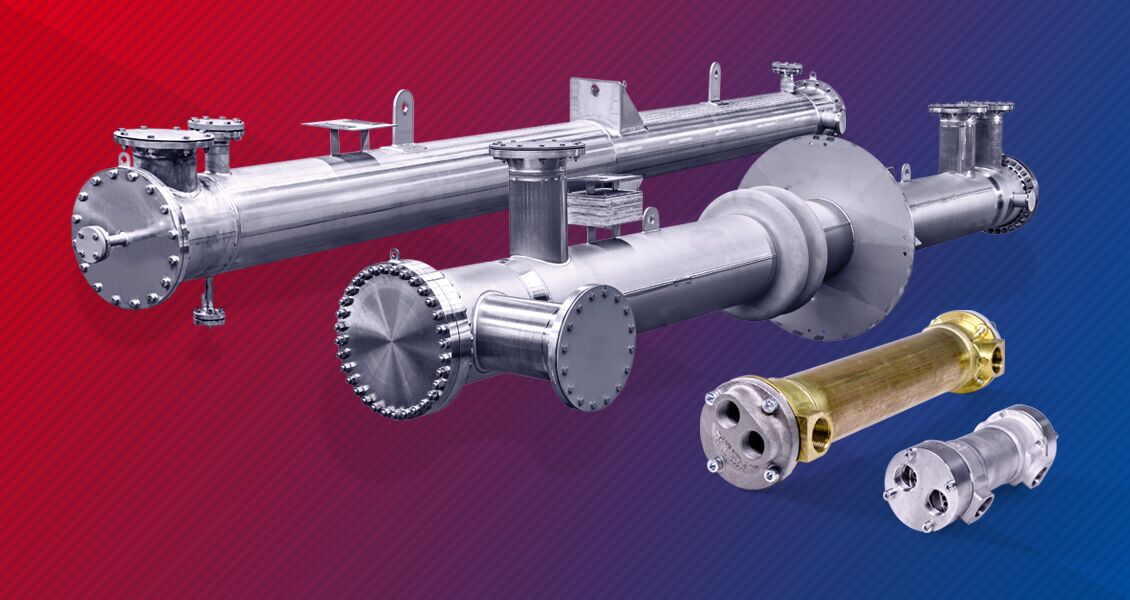
Model series BCF, CCF and SSCF — a modular programme in preselected geometries, used as fluid coolers for oil, water and other operating media. Available in horizontal or upright installation.
Figures describe the model series as a whole. Size, material and arrangement are fixed at selection, against the duty you send us.
This is a model series for universal use, built as a modular system with exchange surfaces from 0.11 m² to 11.45 m². The programme runs to 110 graduated building sizes across three principal material groups, each available in two construction designs — fixed tube bundle or removable tube bundle.
The versions with a fixed tube bundle are available as tube-side single-pass, two-pass or four-pass. The versions with a removable tube bundle are, for design reasons, only available as single-pass or two-pass.
All types in this standard series can be installed horizontally or upright.
A very wide range of application across current heat engineering tasks. Depending on the operating media and the environmental conditions, these types are frequently used as fluid coolers for oil, water or other operating fluids.
Operation with steam is possible on the shell side only, and is subject to restrictions.
Contaminated operating media should preferably be led through the tubes. The multi-pass design makes it possible to reach the high flow velocity that is desirable there.
Produces excellent heat transfer at low pressure losses. To be selected preferably for thin liquid operating media.
A compromise between excellent heat transfer and acceptable pressure losses. The bundle geometry is favourable in fluid engineering terms, which suits viscid media.
Three letters carry the material group and the bundle type.
Seals are available in PTFE and Viton across the series. The exact material for every component is confirmed per order from the manufacturer's material table.
Documents are published by the manufacturer, so these links always give you the current revision.
Units of this model series correspond to the Pressure Equipment Directive under article 3, paragraph 3, and are therefore not given a CE mark. Exception: for horizontally installed BCF units there is an EC type approval test under module B of the directive, and those types can be supplied with CE marking.
Send your enquiry to Sales@goldengears-egypt.com. Six lines are enough for us to come back with a model and a price.
Source of technical data. Surfaces, size counts, pass arrangements, geometry versions, special versions and acceptance wording come from the Funke shell-and-tube heat exchanger product information, model series BCF/P, CCF/P and SSCF/P. The per-component material matrix is deliberately not reproduced: its cells span several series in the source, and publishing it flattened would risk attributing a material to the wrong model. Materials are confirmed per order.